

Canada’s Confidence Conundrum
Weekly Bloomberg Nanos Canadian Confidence Index Update


Canadian consumer sentiment remains tepid, with the Bloomberg Nanos Canadian Confidence Index (BNCCI) holding steady at 50.77 for the week ending October 10th, 2025—just above the neutral threshold. While this suggests a balance between optimism and pessimism, the underlying data reveal a more nuanced malaise.
The Expectations Index, which gauges forward-looking views on the economy and real estate, dipped to 47.20, its lowest in five months. Only 16% of respondents believe the economy will strengthen in the next six months, a stark contrast to the 47.9% who foresee deterioration. This erosion in economic optimism coincides with persistent uncertainty over Canada-U.S. trade relations and broader global headwinds.
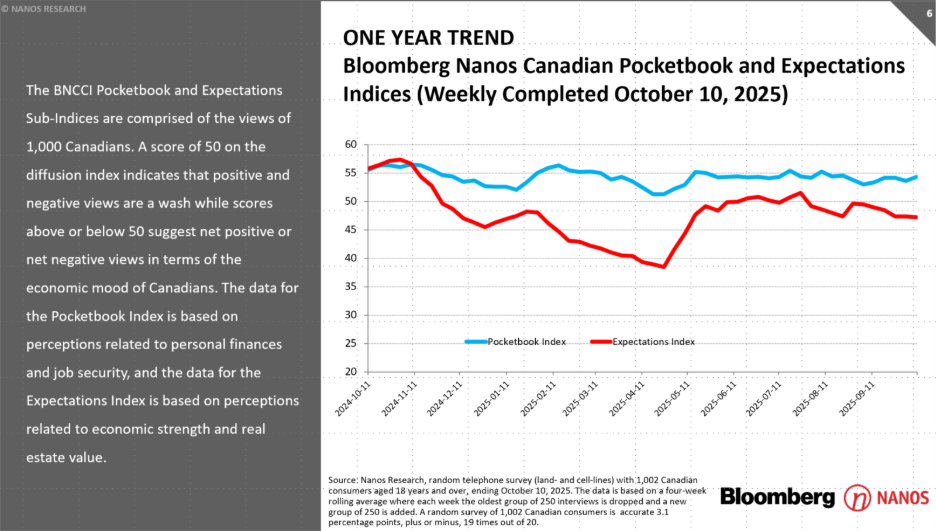
In contrast, the Pocketbook Index, reflecting perceptions of personal finances and job security, edged up to 54.34. Job security remains a relative bright spot, with nearly 65% of Canadians feeling secure in their employment. Yet only 12.4% report being better off financially than a year ago, underscoring the strain of inflation and stagnant wage growth.
Regionally, Quebec leads in confidence, while British Columbia and Ontario lag. Younger Canadians (18–29) are the most upbeat, while middle-aged cohorts express greater caution. Income disparities also shape sentiment: those earning over $75,000 report higher confidence than lower-income groups.
The BNCCI, a diffusion index where 50 denotes equilibrium, has averaged 50.22 in 2025—well below its long-term mean of 54.97. As the federal government navigates economic and geopolitical turbulence, the data suggest Canadians are watching warily, wallets in hand.
For this report and other Nanos data points visit www.nanos.co.

METHODOLOGY
The BNCCI is produced by the Nanos Research Corporation, headquartered in Canada, which operates in Canada and the United States. The data is based on random telephone interviews with 1,000 Canadian consumers (land- and cell-lines), using a four week rolling average of 250 respondents each week, 18 years of age and over. The random sample of 1,000 respondents may be weighted using the latest census information for Canada.
The interviews are compiled into a four week rolling average of 1,000 interviews where each week, the oldest group of 250 interviews is dropped and a new group of 250 interviews is added. The views of 1,000 respondents are compiled into a diffusion index from 0 to 100. A score of 50 on the diffusion index indicates that positive and negative views are a wash while scores above 50 suggest net positive views, while those below 50 suggest net negative views in terms of the economic mood of Canadians.
A random telephone survey of 1,002 consumers in Canada is accurate 3.1 percentage points, plus or minus, 19 times out of 20. This report is based on the four waves of tracking ending October 10, 2025.

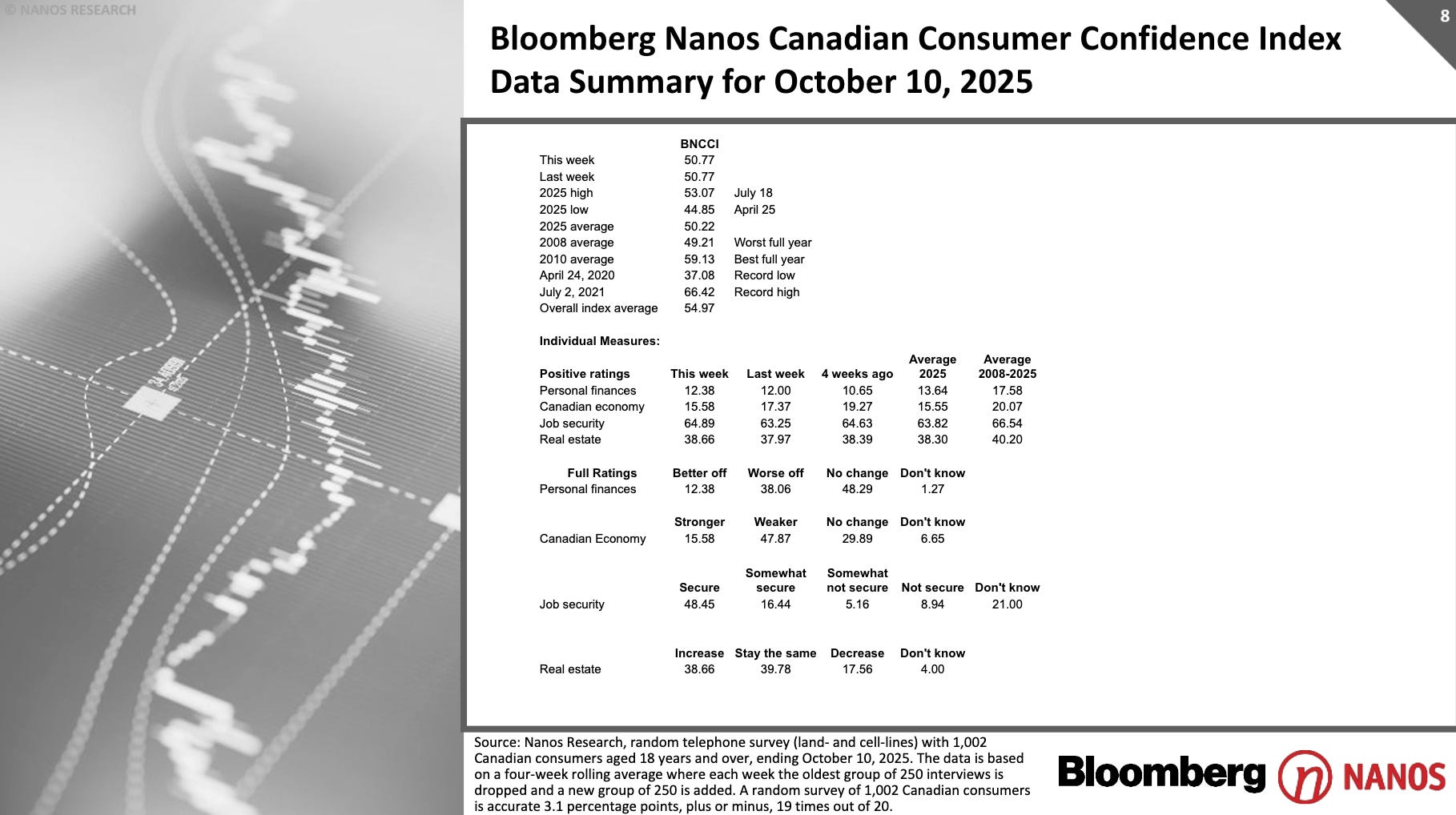
Bloomberg Nanos Canadian Consumer Confidence Index
Data Summary RELEASED for October 10, 2025
If you are not on our distribution list and wish to receive automatic poll and media updates by email for free go to the main Nanos site or our Substack and submit your email address. Thanks for your interest in our data. Feel free to forward this email.

NANOS IS YOUR GO-TO HIGH-STAKES RESEARCH PARTNER.
Delivering world-class solutions since 1987, we are the leader in high velocity data insights and visualization.
Market | Consumer | Reputation | Policy | Insight
Contact us today or visit our website